Free 13-Week Cash Flow Forecast Template (Excel)
Download a free 13-week cash flow forecast in Excel with weekly receipts and payments, minimum-cash alerts and actual-versus-forecast variance tracking.
A 13-week cash flow forecast is the tool lenders, CFOs and turnaround advisers reach for when cash matters more than profit. It shows, week by week, exactly how much cash will come in, what must go out and whether the balance stays above the level the business needs to operate safely.
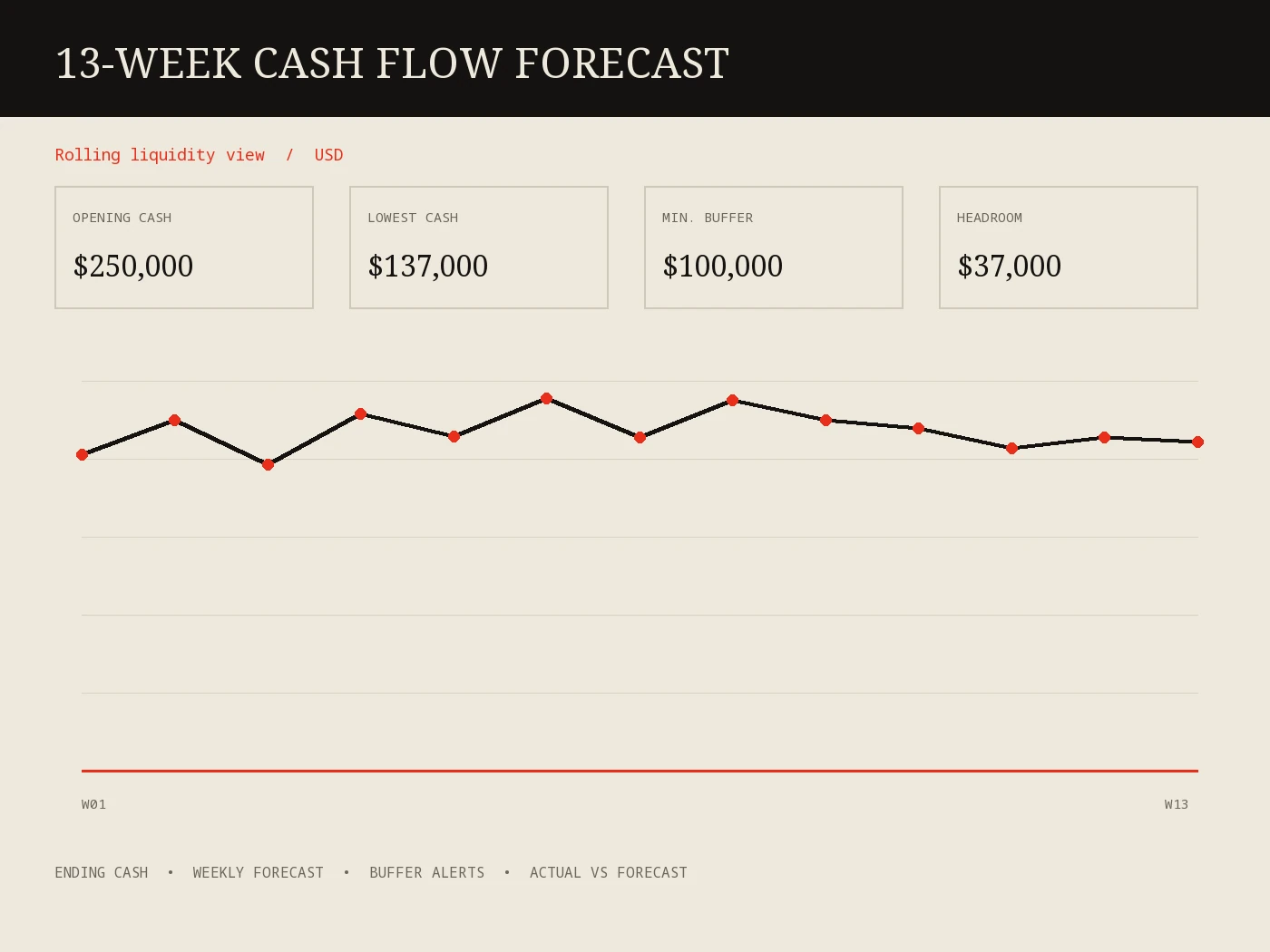
Weekly receipts, payments, ending cash and a minimum-cash alert in one sheet.
Why 13 weeks?
Thirteen weeks is one quarter: long enough to see payroll cycles, rent, VAT or sales-tax payments and loan repayments, yet short enough to forecast from real invoices and purchase orders rather than guesses. Banks often ask for it during covenant discussions because it is concrete and easy to test against actuals.
What is included
| Sheet | What it does |
|---|---|
| Dashboard | At-a-glance summary of cash position, lowest week and runway. |
| Instructions | How to set up the forecast, colour conventions and a weekly update routine. |
| Weekly Forecast | Opening cash, receipts, operating and financing payments, net flow, ending cash, a minimum-cash buffer check and a runway chart. |
| Actual vs Forecast | Enter actual weekly figures to see variance in value and percent, so the forecast improves every week. |
How to use it
- Set the start date and opening cash. Use the bank balance on the first day of week one.
- Set your minimum cash buffer. The sample uses $100,000. Weeks that fall below it turn red and show "ACTION REQUIRED".
- Forecast receipts. Base customer collections on your receivables ageing and realistic payment behaviour, not invoice due dates.
- Forecast payments. Enter payroll, suppliers, rent, taxes, debt service and capital spending in the week the cash actually leaves.
- Update weekly. Record actuals, review variances, then roll the forecast forward one week.
Reading the results
- Lowest ending cash tells you the tightest week of the quarter and how much headroom you really have.
- Weeks below the buffer give you time to act: chase collections, delay discretionary spend or arrange a facility early.
- Persistent variances usually point to one wrong assumption, often customer payment timing.
Build the opening balance from the bank, not the ledger
Start with the cash you can actually use at the beginning of the forecast. Reconcile each included bank account to a statement or online balance at the same cut-off. Record uncleared payments separately so they are not deducted twice: once in opening cash and again in forecast payments.
Restricted deposits and money held for customers are not ordinary operating cash. Keep them outside the available balance or identify them separately. An undrawn overdraft is borrowing capacity, not cash in the bank; show a planned draw as a financing receipt in the week you expect it to arrive.
If you consolidate several entities, remove transfers between their included bank accounts from consolidated receipts and payments. Otherwise the forecast exaggerates activity even when ending cash happens to be correct. Convert foreign-currency accounts consistently and document the exchange-rate assumption; this workbook is not an automatic currency-consolidation system.
A worked weekly cash example
Suppose your unrestricted opening cash is $150,000 and the minimum buffer is $100,000. All figures below are illustrative.
| Cash movement in week one | Amount |
|---|---|
| Opening cash | $150,000 |
| Customer collections | $80,000 |
| Payroll | ($60,000) |
| Supplier payments | ($45,000) |
| Rent and other operating payments | ($10,000) |
| Ending cash | $115,000 |
| Headroom above the buffer | $15,000 |
The calculation is opening cash plus receipts minus payments: $150,000 + $80,000 − $115,000 = $115,000. The $15,000 headroom is the useful decision number, not the $80,000 sales collection.
If $25,000 of the collections slip into week two, ending cash becomes $90,000: $10,000 below the buffer. Do not remove the delayed collection altogether; move it into the expected receipt week. That preserves the distinction between a timing problem and a permanent loss.
A positive weekly closing balance also does not guarantee you can make every payment within that week. If payroll goes out on Tuesday and a major customer pays Friday, build a daily view for that tight week before relying on the weekly result.
Turn receivables and payables into dated cash movements
Use an aged receivables report to identify open invoices, then give material receipts an expected collection date based on customer behaviour and current promises. A 30-day invoice paid consistently after 55 days should not be forecast at day 30 just because the terms say so. Separate disputed debts from routine collections, and identify speculative new sales rather than mixing them with confirmed invoices.
For payments, combine open payables with items that may not yet have an invoice: payroll, employer contributions, tax instalments, rent, subscriptions, insurance and debt payments. Use the expected bank payment date. Include capital purchases and financing movements separately so an operational cash shortfall is not hidden by a planned loan draw.
Keep the treatment of VAT or sales tax consistent. If bank receipts and supplier payments include tax, forecast their gross amounts and show the settlement to the tax authority separately. Do not enter net invoices, gross cash collections and another full tax payment without reconciling the difference.
Run a weekly forecast meeting
- Close the completed week. Enter actual receipts and payments and reconcile closing cash to the bank.
- Keep a copy of the old forecast. Compare actuals against what you predicted before overwriting assumptions.
- Explain the largest differences. Tag each as timing, permanent amount change or missing item; assign an owner where action is needed.
- Refresh the remaining weeks. Move delayed collections and payments to credible new dates, then add a new thirteenth week in your working copy.
- Agree actions. Record what must happen, who is responsible and the latest safe decision date.
In the Actual vs Forecast sheet, check the sign convention before interpreting a variance. A positive receipts difference may be favourable; a positive payments difference may mean more cash went out than expected. Percentage variances are not meaningful when the forecast amount is zero, so discuss the absolute difference instead.
Test a downside case before you need one
Save a separate copy and delay the largest customer receipt by one or two weeks. Then test an unexpected payment and a lower collection rate. Change one assumption at a time initially so you can explain which risk causes the minimum-cash breach; combine them afterwards for a more severe case.
Match the response to the cause. Collection delays may call for invoice follow-up or a short-term facility; recurring operating deficits require a different conversation about costs, pricing or funding. Do not make the forecast balance by entering an unapproved financing receipt. Show the gap until the funding is sufficiently certain.
Frequently asked questions
Is this the same as a cash flow statement?
No. This forecasts future bank movements using a direct receipts-and-payments approach. An accounting cash flow statement explains cash movements for a reporting period and is often prepared indirectly from profit. Both matter, but they answer different questions.
How do I choose the minimum cash buffer?
The sample $100,000 is not a recommendation for every business. Set the buffer around payroll, critical suppliers, timing uncertainty and any lender requirements. Revisit it when the business or payment cycle changes.
Does the workbook update from my bank automatically?
No. Replace the sample inputs and enter weekly actuals yourself. A system connection is a separate piece of work; the downloadable template is a starting point, not a bank feed.
Common mistakes
- Forecasting revenue instead of cash collected.
- Forgetting quarterly or annual payments such as tax, insurance and bonuses.
- Never comparing to actuals, so the forecast never becomes more accurate.
Important limitations
This is a planning template, not financial or accounting advice. Sample figures are illustrative and must be replaced with your own data.
Need it connected to your systems?
A forecast that pulls receivables, payables and bank data automatically saves hours every week. Request a custom cash forecast, or see the five-year SaaS financial model for longer-range planning.
Related: AI grants for small businesses (plan the cash gap before funding lands) and how to file your own US taxes (set aside estimated tax). Need a multi-entity or bank-linked version? See financial analytics services.